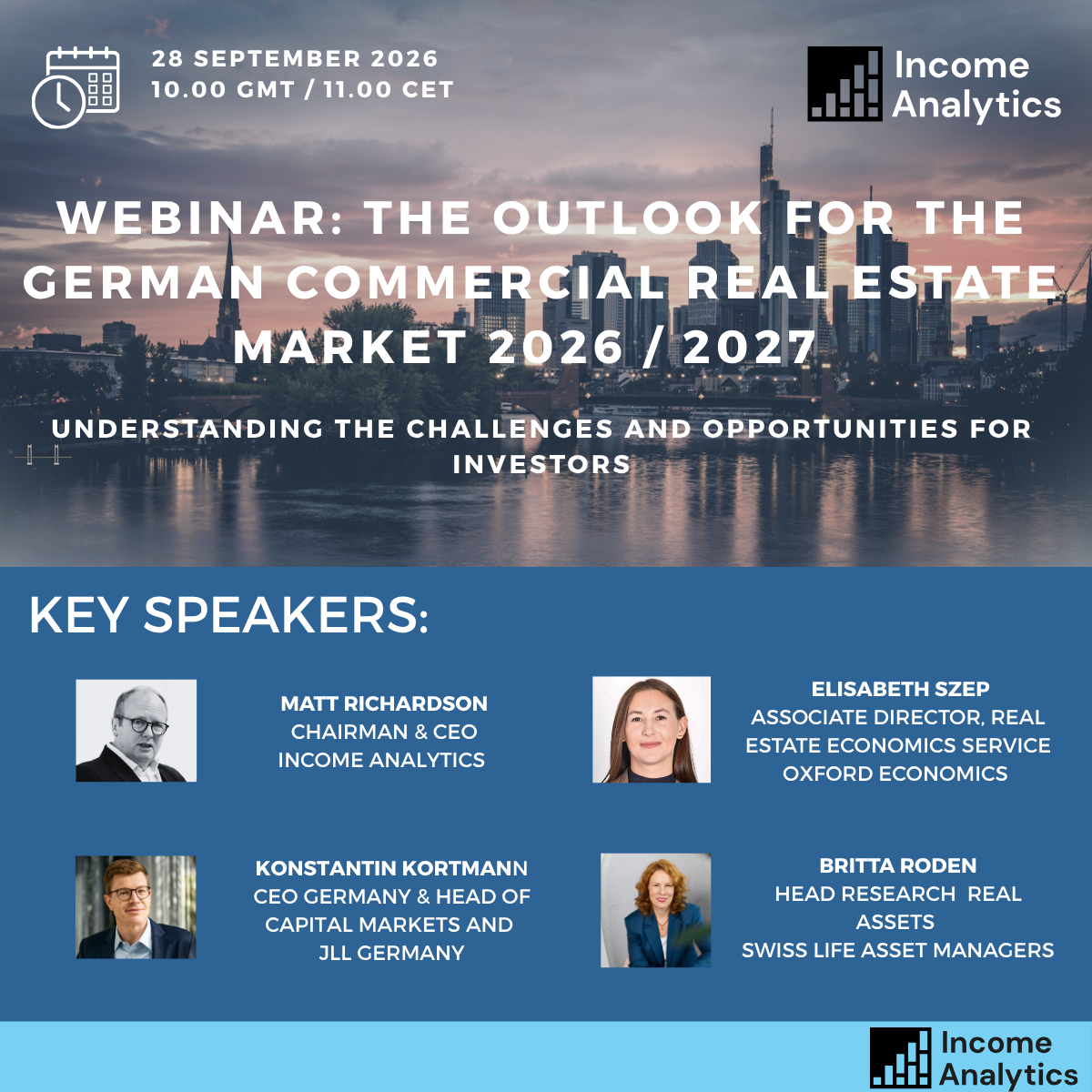
Income Analytics’ latest webinar examined the outlook for Germany’s commercial real estate market over the next 12 to 18 months. The panel’s central message was cautiously constructive: Germany’s economic growth is expected to recover as defence and infrastructure investment gathers momentum, but higher bond yields, further repricing and sharp differences between prime and secondary assets mean that returns will depend increasingly on income growth, active management and disciplined stock selection.
Key speaker insights
Elizabeth Szep, Associate Director, Real Estate Economics Service at Oxford Economics, expects fiscal stimulus to lift German growth, with industrial and logistics among the clearest real estate beneficiaries. However, elevated bond yields and weak office fundamentals mean pricing remains challenging.
Dr Konstantin Kortmann, CEO Germany and Head of Capital Markets at JLL, stressed that Germany’s polycentric structure demands city- and sector-specific analysis. He sees strong tailwinds for industrial and logistics, alongside sharp bifurcation in offices and retail.
Britta Roden, Head of Real Assets Research at Swiss Life Asset Managers, characterised the market as K-shaped: prime assets are improving, while weaker stock continues to lag. She sees opportunity in repricing where specialist managers can actively grow income.
Main themes
-
Economic recovery is becoming more credible. Fiscal stimulus, especially defence and infrastructure spending, should help German growth recover and support industrial regions and major logistics hubs.
-
Higher rates still require further repricing. With German government bond yields elevated, investors need a clearer premium from property. Income growth and asset management must increasingly compensate for tighter yield spreads.
-
The market is bifurcating. Prime, modern and well-located assets are experiencing strong occupier demand, while weaker buildings and locations face falling values, obsolescence and, in some cases, conversion to alternative uses.
-
Industrial and logistics offer the clearest tailwinds. Defence production, resilient supply chains, nearshoring and continued e-commerce growth are supporting occupier demand and investment prospects.
-
Office performance will be highly selective. Scarcity is driving rental growth at the very top of the market, but secondary offices face high vacancy, demographic pressures and a difficult supply-demand balance.
-
Retail has moved from broad avoidance to selective opportunity. A decade of correction, reduced supply and attractive entry yields have improved the case for resilient formats, although inflation may restrain near-term rental growth.
-
Operational capability is now central to returns. Shorter leases, more tenant flexibility and management-intensive strategies mean investors must work more closely with occupiers and operators rather than rely on passive income.
Takeaways for commercial real estate investors
Germany may be approaching the start of a new property cycle, but the recovery will not lift every asset equally. Investors need to underwrite at city, sub-market and building level, with particular attention to the durability and growth potential of income. Industrial and logistics have the strongest broad-based support; prime offices can benefit from scarcity; selected retail and operational assets offer value where specialist management can improve performance. By contrast, structurally weak offices may require substantial repricing or repurposing before they become investable.
The panel’s conclusion was that this is a market for long-term investors prepared to create value, not simply wait for it. The strongest opportunities are likely to emerge where improving economic demand, constrained supply and skilled operations combine. In a higher-rate environment, successful strategies will be built around relative value, rental growth, resilient cash flow and active management.
*****************************
A special thanks to our respected speakers for this webinar:
Elizabeth Szep, Oxford Economics, Konstantin Kortmann, JLL Germany and Britta Roden, Swiss Life Asset Managers
Thanks to all that joined us, if you missed it, please click here for a copy of the recording.